
A brief explanation about Jujutsu 合気拳法柔術
Jujutsu (柔術, literally meaning the “art of softness”) is a Japanese martial art that emphasizes throwing techniques, joint manipulations, and the striking of vital areas to effectively control, subdue or injure an attacker. Jujutsu has many ryuha (流派) based on either Koryu (古流, literally old stream or classical) traditions with a clear lineage handed down from generation to generation or Gendai budo (現代武道, meaning “modern martial way”), generally based on modern interpretations of pre-Meiji Restoration Japanese armed and unarmed martial traditions.
Some History
Japanese martial arts represent an enormous variety of fighting arts indigenous to its culture. At least three Japanese terms are currently used interchangeably to describe this phenomenon: “budo” 武道, literally meaning “martial way”, “bujutsu” 武術, which has no perfect translation but means something like science, art, or craft of war, and “bugei” 武芸, literally meaning “martial art.” The term “budo” is a modern one, and is normally intended to indicate the practice of martial arts as a way of life, encompassing physical, spiritual, and moral dimensions with a focus of self-improvement, fulfilment, or personal growth. The terms bujutsu and bugei have more discrete definitions…at least historically speaking. Bujutsu refers specifically to the practical application of martial tactics and techniques in actual combat. Bugei refers to the adaptation or refinement of those tactics and techniques to facilitate systematic instruction and dissemination within a formal learning environment.
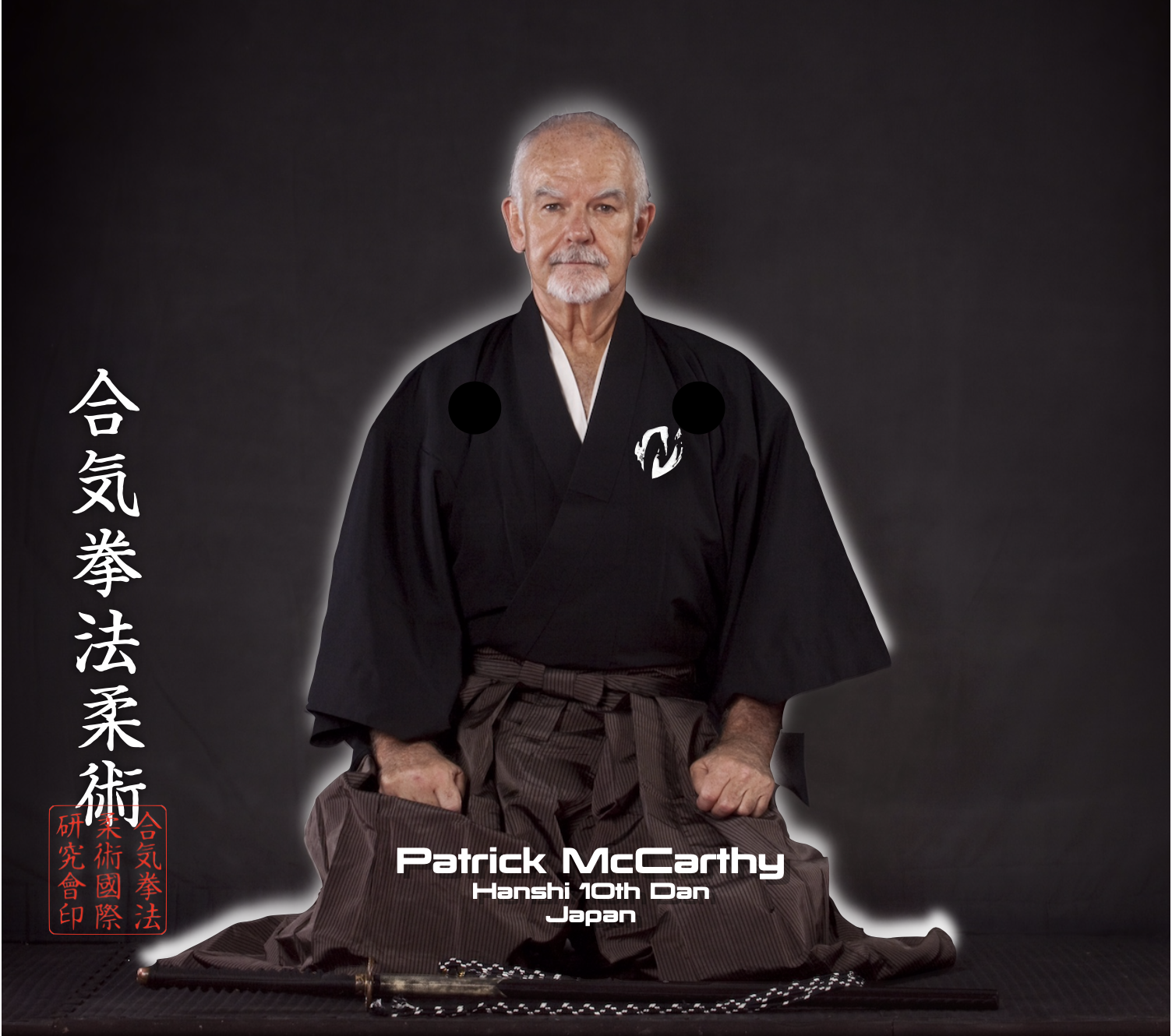
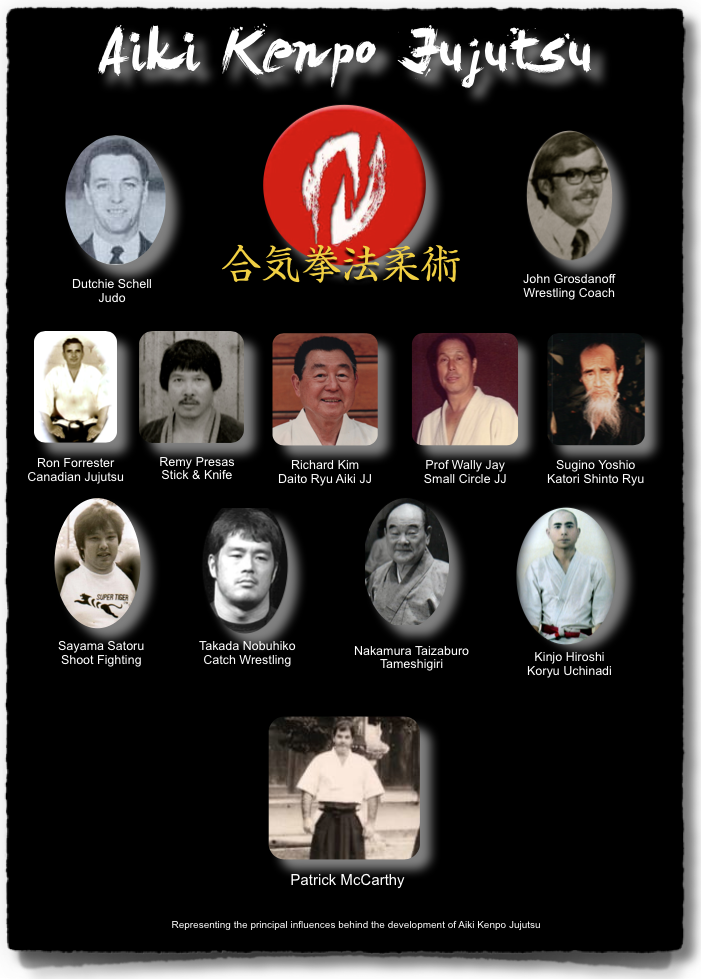
Gendai Budo 現代武道, is a generic term used to describe those Japanese martial arts which are considered “modern”. For example, an art founded after the beginning of the Meiji Restoration [1868], or an art that changed its methodology in such a way that it lost Koryu status, is subsequently considered gendai budo. Aikido, judo, and karate are good examples of gendai budo founded in the modern era, while iaido [sword drawing] represents the modernisation of a practice, which had already existed for centuries. By definition, Aiki Kenpo Jujutsu [herein described as … AKJJ] is a gendai budo, and it represents a collective modernisation of classical practices, some of which date back before 1868 and contemporary insight, gleaned from McCarthy’s years as a collegiate wrestler and an open competitive fighter.” You might be interested to know that McCarthy also studied both Koryu and Gendai traditions [principally, Jujutsu and Swordsmanship i.e. Tenshin Shoden Katori Shinto Ryu/天真正伝香取神道流 directly under the late Grandmaster Sugino Yoshio/杉野 嘉男 and Grandmaster Hatakeyama Goro/畠山五郎, Muso Shinden Eishin Ryu/無雙神傳英信流 directly under Grandmaster Izawa Toshihiko/伊澤俊彦先生 , Koga Ryu/甲賀流 directly under Grandmaster Inoue Motokatsu/元勝 井上, Shoot-Fighting with its founder Sayama Satoru/佐山 聡, boxing with legend coach Yamagami Junichi/ 山神淳一and Submission Grappling [i.e. Catch Wrestling] under Takada Nobuhiko/髙田延彦] during the many years he resided in Japan. Having come to understand and appreciate the wonderfully functional simplicity of these disciplines, McCarthy Sensei couldn’t help but borrow liberally from their conceptual framework when developing a contemporary delivery system for AKJJ.
Old Japanese fighting traditions customarily preserved the contents of their origins, founder, history, philosophy, and practices on secret parchment scrolls called Makimono [巻物]. The modern Japanese term commonly used to describe the various styles or schools of such fighting traditions is Ryuha [流派]. The term Koden [古伝] means ancient tradition, and Koryu-den [古流伝] is how we describe the transmissions of each ancient Ryuha. The teachings of any Ryuha were normally imparted to an apprentice through direct and oral transmission.
Ranking Systems
Currently, there are two ranking systems used in Japanese martial arts/ways:
* Menkyo 免許 System
* Dan/Kyu 段/級 System
Classical schools (koryu) use the menkyo system as a means of licensing their learners, while the dan/kyu system is used by schools that base their practice on modern budo. The modern dan/kyu system was created by innovator and Judo founder, Kano Jigoro, during the late nineteenth century to accommodate the learners of his Kodokan-based Jujutsu practice, before becoming adopted by other gendai budo.
Menkyo System/免許
Menkyo is a Japanese term meaning “license”. Dating back to the 8th century, it refers to the permission of the education system for practitioners of various Japanese arts and ways in order to maintain traditions within ryuha.
Menkyo Kaiden/免許皆伝 is a term meaning “license of total transmission.” It is the final license granted by a school, indicating that the instructor has learned all aspects of the ryuha. The holder of a menkyo kaiden is often, but not always, the de facto successor to the style of the ryuha. In AKJJ, we use both systems:
AKJJ History
Aiki Kenpo Jujutsu is NOT a Koryu but rather a contemporary discipline based on Patrick McCarthy’s interpretation of classical tradition. Having studied the martial arts since childhood and excelling as a competitive athlete, McCarthy had the good fortune to study and train under some of the leading authorities of the fighting arts all over the world, including Japan.
Ancient Maxims
Early in his training, he was taught the value of two ancient maxims, which would ultimately alter the course of his future: Bun Bu Ryu Do [文武両道] and On Ko Chi Shi [温故知新]. The depth and meaning of this wisdom greatly impacted his understanding of tradition and set him on a course of challenging the status quo!
* “Bun Bu Ryu Do” (文武両道) is a Japanese term that can be translated as “Pen and Sword in Accord” or “Both Literary and Martial Ways.” It reflects the idea of balancing intellectual and martial pursuits, emphasizing the importance of cultivating both the mind and the body harmoniously. This concept aligns with the traditional values often associated with martial arts, promoting not only physical prowess but also intellectual and ethical development.
* “On Ko Chi Shi” (温故知新) is a Japanese proverb, and in Chinese, it is written as “Wen Gu Zhi Xin” (温故知新). This phrase can be translated as “Study the old to understand the new” or “Review the past to know the present.” It conveys the idea that by studying and reflecting on historical knowledge or past experiences, one can gain insights and understanding that are valuable for facing current challenges or learning new things. The proverb emphasizes the importance of drawing wisdom from the past to navigate the present and future.
As a young black belt in the early 1970s, McCarthy was deeply inspired by the Dragon, Bruce Lee! Lee advocated function over form and discarding overly ritualized practices that had become wholly dysfunctional. Because the art was so steeped in Confucian-based culture [i.e., ancestor worship], which frowns upon challenging authority, Lee believed that generations of practicing templated routines, without aggressive resistance, ultimately lead to a tradition becoming dysfunctional. Deeply moved by Lee’s ideas, McCarthy sought to better understand the value of tradition.
Echoing the words of Matsuo Bashō [松尾 芭蕉, 1644-1694], “Do not seek to follow in the footsteps of the wise; seek what they sought. Seek the meaning behind their footsteps, and not upon the steps themselves.” As each of our paths will be different, too often following the path of another doesn’t lead to where you need to go! Paraphrasing the words of Gustav Maher, “Tradition, when embraced, is not about safeguarding or venerating mere ashes confined in a box; instead, it’s the meticulous preservation of the eternal flame. It should catalyze inspiration, fostering growth and progress, rather than impeding them.”
Tradition
Many things have helped shaped McCarthy’ Sense’s understanding of tradition but it was a passion with cultural anthropology and studying the works of the late Joseph Campbell that compelled him to reevaluate its meaning; “Every generation produces individuals who, to keep their traditions a living experience in the communities that they serve, find reason to reinterpret the common principles upon which it rests. In doing so, more innovative ways of achieving the same outcome are accomplished.” Based upon the two maxims [Bun Bu Ryo Do & On Ko Chi Shin], and the words of Matsuo Basho & Gustav Mahler, Campbell’s insights allowed McCarthy to see the true value of how tradition should serve to inspire, not impede.
So, one of the problems that exists in the traditional fighting arts is deifying its teachers or leaders to the point where they are placed on pedestals beyond reproach, and there is no questioning of authority! Those who challenge the status quo are very often ridiculed, criticized, and/or ostracized and described as being disrespectful or dangerous. In this regard, and so often like religion, the fighting arts are too often cult-like and more about the personalities, not the principles! Therefore, trying to make changes in the name of progress is not only frowned upon, it’s regarded as a threat! McCarthy Sensei not only faced this continuously, but he also became the target for all those who did not understand the true meaning of tradition and chose to protect the ashes rather than kindle the flame!
The Process Not The Person
By the time he came to understand that it was more about believing in the process rather than submitting to a person, McCarthy Sensei was able to immerse himself in developing both a functional and systematised curriculum that conditions the body, cultivates the mind, and nurtures the spirit.
Contextual Premise: The HAPV
Quantifying the acts of physical violence, which are habitual in human nature, irrespective of culture, gender, or age, McCarthy provided the contextual premise through which to arrive at a wonderful clarity, not impeded by style, rules, and regulations, nor organizational politics or commercial exploitation!
Although an entire dissertation might better describe his lengthy journey, the analysis ultimately brought about a sense of transparency. Together with an appreciation of Zen-based simplicity, a profound love of Japanese culture, and a desire to honour the heritage of its pioneers, his work formed the foundation upon which Aiki Kenpo Jujutsu [and Koryu Uchinadi] was established; AKJJ is a contemporary interpretation of classical tradition.
Aiki Kenpo Jujutsu [Empty-Hand] Core Practice; Based upon the HAPV Contextual Premise
#1. Giving & receiving percussive impact/blunt force trauma: Uchi/Uke-waza [29 techniques]
#2. Negotiating the clinch: Tegumi: Kotekitai, Kakie, Ude Tanren and Muchimi-di, etc. [36 techniques]
#3. Joint manipulation, cavity seizing & limb entanglement: Kansetsu/Tuite-waza [72 techniques]
#4. Chokes/strangles-air/blood deprivation: Shime-waza [36 techniques]
#5. Balance displacement: Nage-waza [55 techniques]
#6. Ground-fighting & submission: Ne-waza [72 techniques]
#7. Escapes & counters: Gyaku-waza [36 techniques]
Aiki Kenpo Jujutsu [Weapon-related] Practices
#8. Swordsmanship: A contemporary/modified interpretation of Sugino-ha [Tenshin Shoden Katori Shinto Ryu 天真正伝香取神道流] Kenjutsu, based upon using the Tachi [太刀/sword, 12 kata], Kodachi [小太刀/short sword, 3 kata], and Ryoto [両刀/two swords, 4 kata]. Curriculum also includes Iai-jutsu [居合術/sword-drawing, 16 kata], Tameshigiri [試し斬り/test cutting, 4 kata], and free-style fighting [without protective equipment] with bokken [wooden] and live metal [non-sharpened] blades.

Videos of Our Practices
Note: Aiki Kenpō Jujutsu (AKJJ) and Koryū Uchinadi (KU) 2-person practices are identical. The following clips illustrate the shared pedagogy and methodology.
-
Aiki Kenpō Jujutsu – The Pathway 101 #4
https://youtu.be/K4CSjJngSN0?si=fbkoMVImuAGhXsnG -
Aiki Kenpō Jujutsu – The Pathway 101 #5
https://youtu.be/YO0ARcEIG6g?si=d2r5z0lUQCVvIMle -
Aiki Kenpō Jujutsu – The Pathway 101 #7
https://youtu.be/YO2iCCi-QRc?si=gLBkdiHbE1P0yD06 -
Aiki Kenpō Jujutsu – The Pathway 101 #8
https://youtu.be/VvIBNEuLe0w?si=CXI3WSQieGUcXzr- -
Koryū Uchinadi Taisabaki Oyo-waza #5
https://youtu.be/qsvGYMMXV7g?si=OpWG-pAOchhjRwj5 -
Koryū Uchinadi Taisabaki Oyo-waza #6 – Alternative view 1
https://youtu.be/R757dC3Urwg?si=HnzIx4H-mHOENbG5 -
Koryū Uchinadi Oyo-waza fusion drill – Alternative view
https://youtu.be/zusKb_7yivk?si=rPgWBdeYkp8Vg43B -
More in Kata and the KU Pathway Practices
https://youtu.be/qtgy1EmdFF0?si=sLZzHy7Vqj4aH4Vd
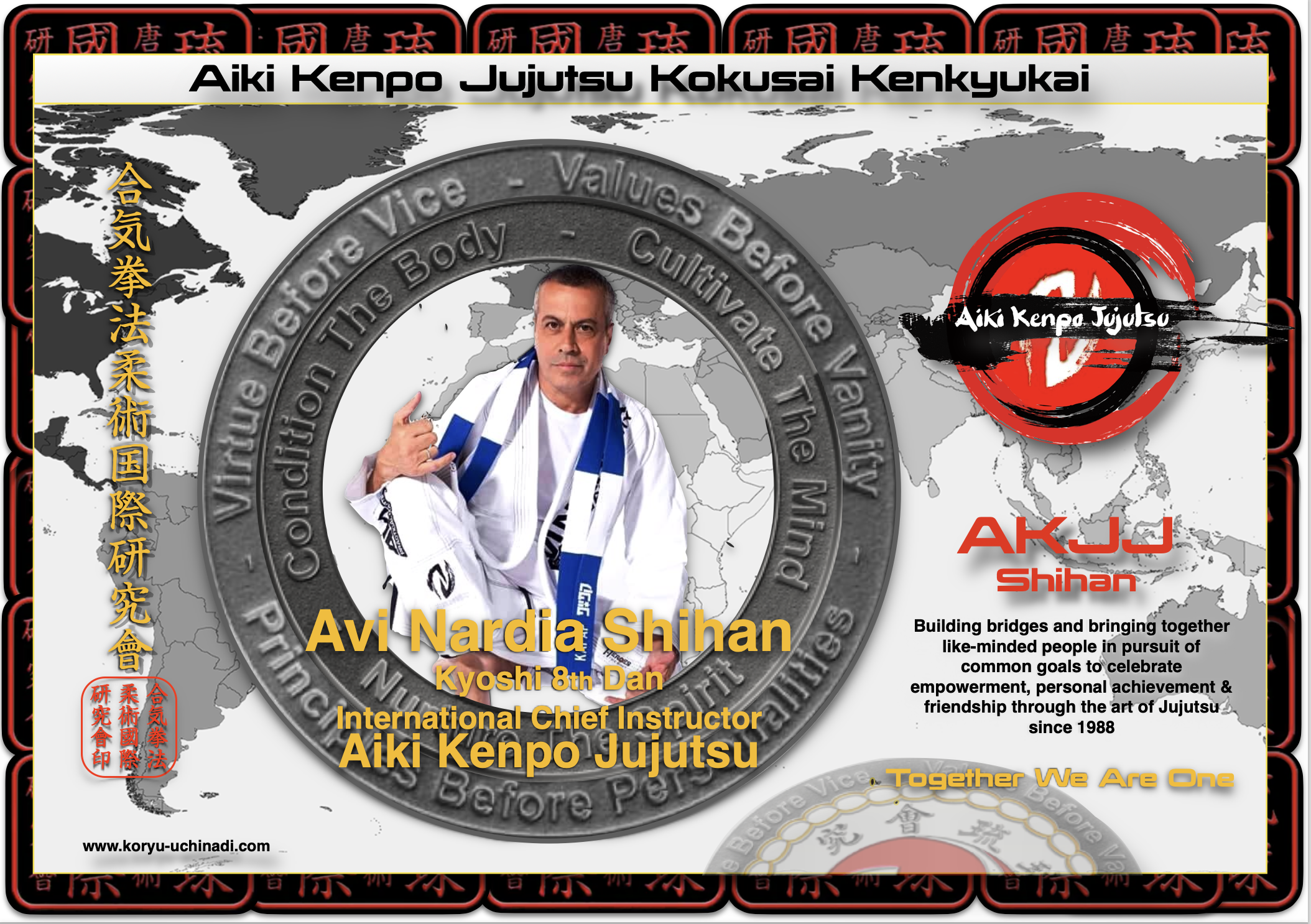 Major [ret] Avi Nardia – Aiki Kenpo Jujutsu Shihan 8th Dan – International Chief Instructor
So-honbu Dojo
Japan [Okinawa] – Patrick McCarthy, Hanshi 10th Dan patrick_mccarthy@mac.com
Shibu/Branch Dojo
Serbia [Belgrade] – Shihan Avi Nardia, Shihan 8th Dan avi@avinardia.com
USA [Sewell, NJ] – Shihan Paul Lopresti, Shihan 7th Dan Phooey3587@aol.com
Canada [Scarboro, ON] – Sensei Carlos Newton Shihan 5th Dan ultimateicf@live.ca
Netherlands [Veldhoven] Huub Meijer, Shihan 7th Dan bert.mollen@koryu-uchinadi.nl
The Netherlands [Breda] Martijn de Bruijn martijn.debruijn@guerbet.com
Norway [Sandefjord] – Kjetil Ringdal kringdal@icloud.com & Espen Halvorsen esphal@globalconnect.no
Australia
* Sensei Bill Johansen, Renshi 6th dan [Brisbane So-honbu] billjohansen@rocketmail.com
* Sensei Luke Seigmeier, [Biloela, QLD – Shibu] Siegmeier1@gmail.com
* Sensei Luke Dickie, [Beenleigh, QLD – Shibu] paivid@yahoo.com.au
* Sensei Lachlan Fischer, [Bayside, QLD – Shibu] gkplint@bigpond.net.au
* Sensei Peter Wetherspoon, [Toowoomba, QLD – Shibu] peter@struxi.com.au
* Sensei Bob King, [Newcastle, NSW – Shibu] rejking@gmail.com
* Sensei Wolfgang Vogel, [Melbourne, VIC – Shibu] urufu@melbourneku.com.au
* Sensei Chris Mazzali, [Denmark, WA – Shibu] mitsudomoe@westnet.com.au
* Sensei Craig Crampton, [Busselton, WA – Shibu] craig.crampton@outlook.com
* Shidoin Dave Beattie, [Sydney, NSW – Shibu] sydneykoshinkan@gmail.com